

In partnership with

One year of writing a newsletter. These are the lessons you can actually use.
👋 Welcome back to Content to Commas, a weekly playbook for creators, founders, and content pros building monetizable brands without burning out.
I began this newsletter in March 2025, and last week I took some time to look back at the past year to figure out what was successful and what wasn't.
My first draft was filled with lots of numbers, like open rates, tips for gaining subscribers, and revenue details, but it ended up being just a collection of highlights.
It was just a flex. Not a playbook. And if you've been reading this newsletter for any length of time … you know that's not what we do here.
So this issue is the rewrite.
More about the 5 lessons I wish someone had handed me at issue #1, pulled from 52 weeks of data, mistakes, and a surprising amount of things that worked.
This issue is a 5-part audit you can run on your own newsletter this weekend so you cut a year off your learning curve.
📌 In this issue:
Growth curve and where subscribers actually came from
The content stack that consistently wins (and why)
The post-mortem habit that beats any "best practice"
The year 2 plan
— Brandon
a message from our friends @ Wispr Flow
Speak naturally. Send without fixing.

Wispr Flow turns your voice into clean, professional text you can send the moment you stop talking. Not rough transcription you have to clean up. Actual polished text — ready for email, Slack, or any app.
Speak the way you think. Go on tangents. Change your mind mid-sentence. Flow strips the filler, fixes the grammar, and gives you text that reads like you spent five minutes writing it.
89% of messages sent with zero edits. Millions of professionals use Flow daily, including teams at OpenAI, Vercel, and Clay. Works on Mac, Windows, and iPhone.
You've heard me talk about Wispr Flow 100 times. I'm even using it right now to write this, and I use it to write every single newsletter every week. Click the link above if you want to see what all the hype is about.
📍Here's what's actually going on
Newsletters seem unsexy to a lot of people.
But I could not recommend it enough. It's a great way to actually reach your audience.
Whether it's on Beehiiv (what I use), Substack, Kit, Flodesk, or any other email service. There's value in audience ownership.
Even if you haven't written a newsletter or started your email list yet, tap in. You can still gain these lessons.
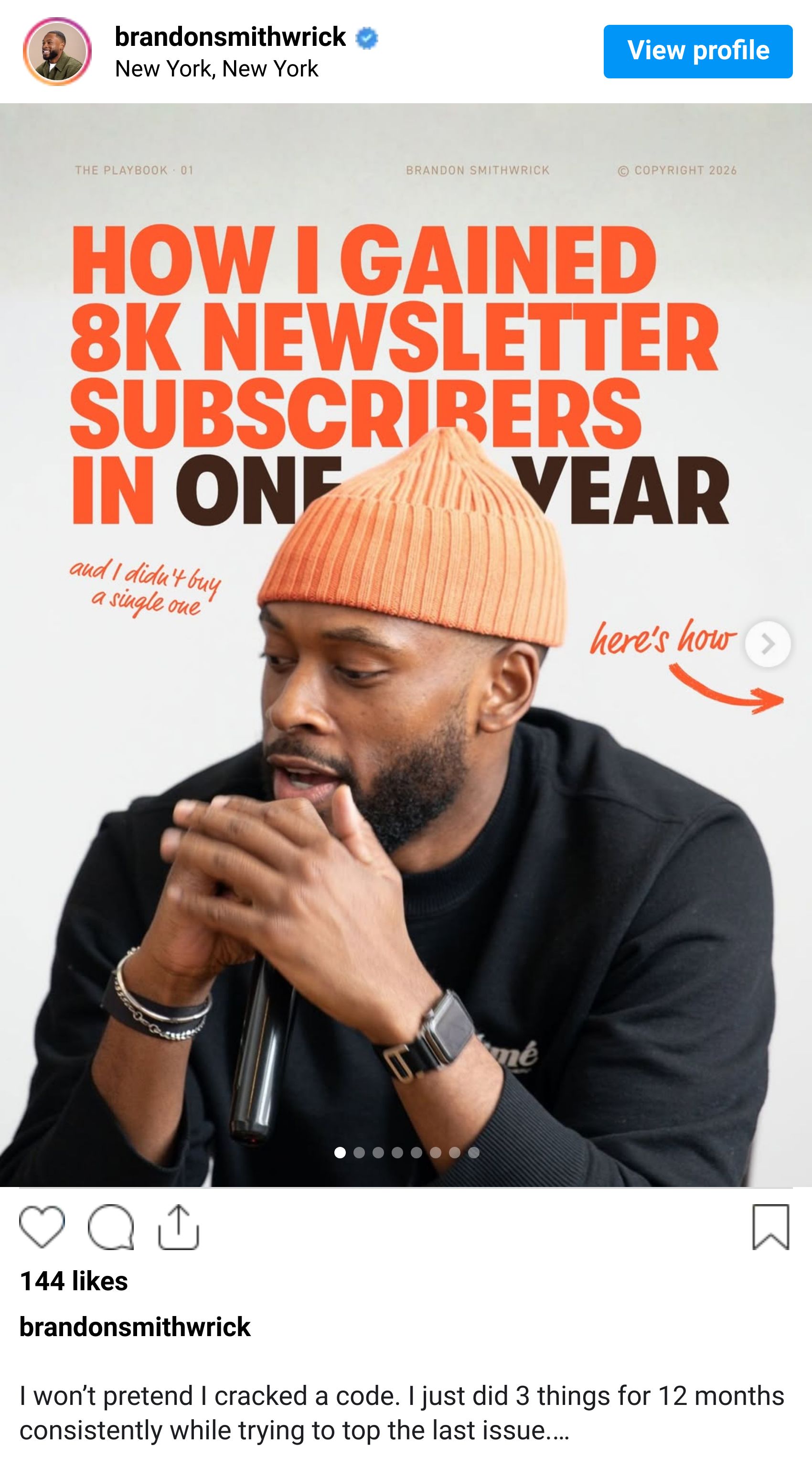
This newsletter will be five lessons that you can apply. If you want to see 3 tactics that helped me gained 8K in one year, click the post below.
🎯 The Year-One Newsletter Audit
5 lessons from 52 issues.
1. Understand your acquisition mix.
Going in, I knew LinkedIn would be a benefit since that audience has already leaned into valuable info, and I assumed other channels like Substack or Threads would help, but data shows differently.
Here's the actual acquisition mix over the last 12 months:
LinkedIn organic: ~55%
Referrals from existing subscribers: ~18%
Cross-promos and newsletter recommendations: ~12%
Threads: ~7%
Podcast and speaking mentions: ~5%
Instagram and other: ~3%
The lesson isn't "post on LinkedIn." It's to figure out how many potential mechanisms can you use on a channel to drive people and migrate your audience. -
LinkedIn actually has a few mechanisms that allow me to do that seamlessly, even though I use Manychat on channels like Instagram.
The channels you choose also play a role. Beehiiv has a ton of cross-promotion features similar to other channels that help you grow automatically.
2. Framework + personal story + specific money number is the stack that consistently wins.
My top 5 issues by engagement all shared the same DNA. They named a system. They had a real story behind them. They included a specific number in dollars.
The top performer walked readers through turning a Cannes L into a $20K deal. Second was a named playbook called The Inbound Engine. Third was The Client Magnet Playbook.
None of them were cleverer than my other issues. They were more specific.
Look at your top 3 issues this year. Look at your bottom 3.
Figure out the pattern in those 6.
The pattern is almost always the same: winning issues are concrete, losing issues are abstract.
Specificity is a trust cheat code. Use it more than you think you should.
3. Post-mortem your losers.
I didn't start doing this until mid way. I should've started in week 1.
My bottom 3 issues of the year taught me more about my audience than the 5 that popped off combined.
A pure CTA email tanked because I asked for a favor without giving value first. A broad roundup tanked because I don't win on roundups. A contrarian take got clicks but burned unsubs because I picked a target that was sacred to a third of my list.
If I'd been running post mortems from issue 1, I'd have cut my year-one learning curve in half.
After every send, answer three questions:
Did this issue sound like me, or like I was trying to sound smart?
Did it give the reader something to do, or just something to know?
Is there a sentence in here I'd defend on a panel?
If you answer "no" twice, the issue wasn't worth the send.
Losers teach faster than winners. Don't skip the autopsy.
4. Your newsletter makes you money. The things in your newsletter make you even more.
Direct sponsor revenue from Content to Commas in year 1 was solid.
The real money lived next to the newsletter.
The affiliate links that give you recurring revenue.
The overall deal numbers that increase because they want to include newsletter alongside other channels.
The speaking opportunities and other stages you access because you can show community
The newsletter is a trust engine. The money lives in the adjacent assets.
List every dollar that touched your newsletter audience, not just newsletter sponsor dollars.
Track "inbound that mentions an issue" as its own metric.
If you're only monetizing the email, you're leaving 70% of the revenue on the table.
Many dislike affiliate deals, but I love them as a secondary income source by ensuring everything I use has an affiliate code.
5. Stances beat roundups.
My worst-performing format in year 1 was the "trends recap."
My best-performing issues had a POV I was willing to defend on a podcast, any day..
My readers didn’t subscribe for my summaries … they subscribe for my opinion.
And once I realized that, each issue I created became clearer because they can get social media and content roundups on 10 other newsletters, but there's only one Content to Commas.
but really … thanks for reading every week. Thanks for the replies that kept me writing past the 4-week mark when I almost pulled the plug.
Year 1 taught me plenty.
Year 2 will take things to the next level.
Until next week, keep building.
Was this issue useful?
📌 ICYMI…
Each week, I share simple tips on branding, making money, growth strategies, and useful tools that you might have missed. You can catch up in just a few minutes.
Posts You May Have Missed…
These posts did numbers for a reason. Worth a reread.
🎬 Headed to Cannes Lions this year? I built an event tracker with every Ad Week, WSJ, Meta, Pinterest, and Adobe activation on the Croisette. Comment "Cannes" on this post and I'll send it your way.
🌊 I got featured in The Workflow: Sara & Diandra broke down my full Content Repurposing Workflow (the Zap, the master prompt, the stack) that turns one newsletter into 29 pieces of content across 6 platforms while I sleep. They even included my prompt to steal → Read the feature + grab the prompt
🔁 The HubSpot Content Multiplier Playbook: The system I built with HubSpot to turn one piece of content into dynamic top, middle, and bottom-of-funnel assets. So your content isn't just living at the top of the funnel collecting likes → Grab the free playbook
🔍 How to Get Discovered in AI Search: Your buyers are asking ChatGPT, Perplexity, and Gemini before they ever hit Google. Here's what to change in your content so you show up when they do → Read the playbook
Community Favorites…
Handpicked for where you are right now.
🎥 The Personal Branding Masterclass: I sat down with a creative agency and broke down my full personal branding system. The positioning, the cadence, the monetization path. Watch it on your lunch break → Watch the masterclass
💼 My Actual LinkedIn Content Strategy: Not theory. The real workflow, weekly cadence, and hook library I run every week to drive subscribers and inbound → Read the strategy
😈 Why Your Content Needs a Villain: How to point your audience at one clear enemy so your POV cuts through and your frameworks actually stick → Read the post
💰 How I 3X'd My Rates at Cannes (Without Burning Bridges): Last year's recap. The exact positioning and script I used to reprice mid-partnership without losing the deal → Read the recap
Tools I Love…
The stack I keep coming back to in my own business.
🧠 Granola: The best AI meeting notetaker I’ve used. No bots joining calls. No interruptions. Just clean notes → Try Granola
📬 Flodesk: Email marketing with design-forward templates and flat-rate pricing that doesn't punish you for growing your list → Start for free
📧 Beehiiv: Newsletters plus websites, podcast hosting, and link-in-bio. Use this exclusive link for 20% off 3 months → Launch a Beehiiv
🎙️ Wispr Flow: The number one tool I use daily. Voice-to-text that actually works, writes 10x faster than typing, and sounds like me. Try it free for a month → Try Wispr Flow
🤖 Stanley: My LinkedIn AI content coach. After talking with the team, I got you 7 days free (the highest they offer). It learns your tone and tells you exactly what's clicking → Try Stanley free for 7 days
⚙️ Relay.app: How I build AI agents without writing a single line of code. If you want to automate your content workflow, start here → Try it free
💬 ManyChat: The tool I trust for social media automations. Comments, DMs, lead capture. It runs in the background so you don't have to → Build the flow
📅 Cal.com: I fired Calendly. This is what I use now. Way more affordable, does everything you need → Make the switch
🏦 Mercury: Business banking that stays clean. Deposit $10K in 90 days and get $250 → Open an account
Free Resources For You…
📷 Content Kit: The exact equipment to build dynamic content → Explore more
🧰 Ultimate Creatorpreneur Toolkit: 70+ tools I used to build a six-figure business, with exclusive discounts → Grab the toolkit
🪝 250 Proven LinkedIn Hooks: Copy, tweak, grow your brand faster → Get the hooks
🤝 How to Land a Brand Deal: Zero-fluff guide to inbound and outreach that works → Learn the playbook

Brandon Smithwrick, Creator of Content to Commas™
Thanks for reading! Say hi 👋 on LinkedIn
If this newsletter helped you make money, save time, or get unstuck… I want the receipt
Was this newsletter forwarded to you? Subscribe here
Interested in advertising? Get in touch

